Distillation
In the process of distillation, concentrations of mixtures and solutions are increased in order to achieve or observe a specific desired result or receive a yield of purified products. When vacuum is applied to the distillation process, the required heat energy drastically decreases, increasing yield and quantity while cutting costs.
Vacuum distillation makes use of the fact that lower atmospheric pressures lower the boiling point of liquids exposed to said atmosphere. A heated liquid in sub-atmospheric conditions is able to boil and evaporate at lower temperatures due to the decreased amount of pressure keeping the excited liquid molecules from releasing the heat energy as kinetic energy, breaking its intermolecular bonds and becoming a gas.
A vacuum pump is connected to a condenser and vessel with a heating element. The vessel contains the product, with the heating element introducing a temperature gradient underneath it. The vacuum pump is first powered to evacuate the system. The heating element is powered so that it maintains a constant temperature within the vessel, often to target the boiling point of a specific constituent of the product. Evaporation occurs, and the vapors pass through the condenser to be collected.
There are many different methods of distillation, including fractional distillation, steam distillation, vacuum distillation, reactive distillation, catalytic distillation, and one of the finest methods of separation, molecular distillation. The difference between molecular distillation lies less in the result and more in the apparatus and method; namely, evaporators.
Two kinds of evaporators stand out in terms of distillation processes: thin film evaporators and short path evaporators. Depending on the kind of evaporator used to vaporize the liquid components, the system setup varies, but both require sub-atmospheric conditions in the system via a vacuum pump.
Short path evaporation, or short path distillation, requires an operating pressure of up to 10-4 mbar and operates with a condenser placed in the center of the evaporator, reducing distance between the hot and cold surfaces and thus decreasing the pressure differential. The operating pressure can only get as low as required because of this decreased pressure differential, which would otherwise negatively impact the purity and quantity of the yield. In this process, feedstock is poured onto the evaporator, which is held at a specific temperature that is the boiling point of one of the components of the liquid mixture. The vapor immediately condenses onto the condensing plate and is piped away to separate storage while the rest of the liquid flows out of the bottom of the apparatus.
Distillation methods can be categorized as molecular distillation if the distance between the evaporator and condenser reaches the mean free path of a vapor molecule. With short path evaporators, molecular distillation occurs. Short path molecular distillation takes seconds and can be generally applied to organic compounds with high molecular weight. Organic compounds will not decay because the high vacuum level brings the boiling points lower, to a value that does not risk the deterioration of heat-sensitive materials.
This is important in applications of manufacturing juices, alcohol, petroleum, and pharmaceutical products, as well as for chemical industry laboratory research applications. Through distillation, products like orange juice are able to meet a certain concentration without additional ingredients, which increases costs over time in operation. The water content of the beverage, juice or alcohol, is partially removed, circulating through the reflux, condenser, and receiver tank for collection. Depending on the particular setup and desired alcohol concentration, the heating unit and condensing unit are adjusted, as well as the vacuum pressure applied by the pump.
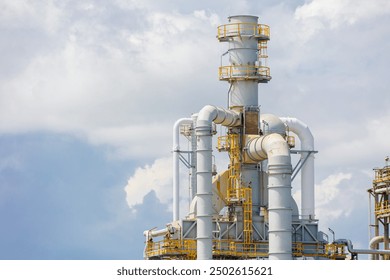
In the petroleum industry, fractional distillation is used to isolate the components of crude oil for use in various different industries. The heating element is used to reach a specific temperature, evaporating one component of the crude oil, before it is increased or decreased to target another component. The vacuum pressure that the pump induces causes atmospherically azeotropic mixtures in components such as naphtha to separate. The vacuum also makes it so that the heat energy required for evaporation decreases, making it safer for the volatile and combustible constituents of crude oil to be safely distilled and extracted.
The pharmaceutical industry takes advantage of vacuum distillation in the manufacture of all kinds of organic compounds such as Vitamin A and E, fatty acids, and polyglycols which are then further processed as ingredients for research and sale as medication.
Short-path molecular distillation is applied for the refining of active pharmaceutical products, concentration of vitamins, manufacturing of pharmaceutical stabilizers, oil stripping for monomer extraction, isocyanate stripping, solvent stripping and oligomer stripping for the manufacturing of resins and polymers, polyglyceride stripping, omega-3 fatty acid concentration, petroleum evaporation and distillation, wax fractionating, lubrication oil production, and extraction of polymers and resins for plastic production, to name a few.
View our Products
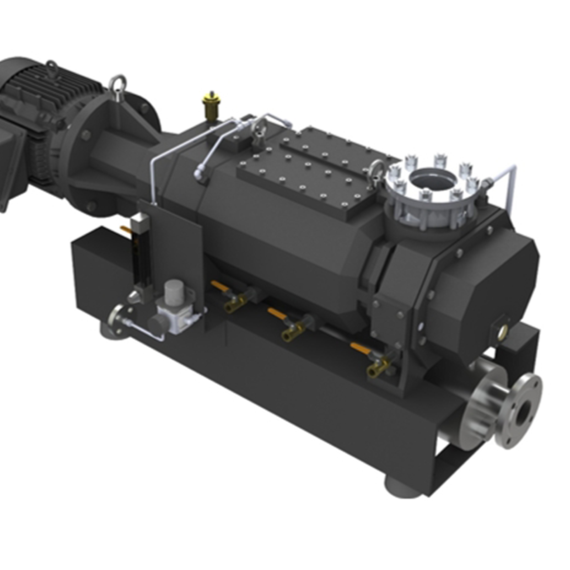
One of the major allures of using a dry screw vacuum pump is that it does not use any working fluids, drastically reducing contamination of the product and dropping the ultimate vacuum level lower than a pump that is limited by its working fluid’s vapor pressure. In food and pharmaceutical applications, this is a valuable property because the working environment is held to specific standards regarding cleanliness and contamination. The dry screw vacuum pump is easy to purge, and its chamber is easily accessible for cleaning, maintenance, and repair. The NSP Series is available in stainless steel for applications such as petroleum distillation which require resistance against potentially corrosive process gasses.
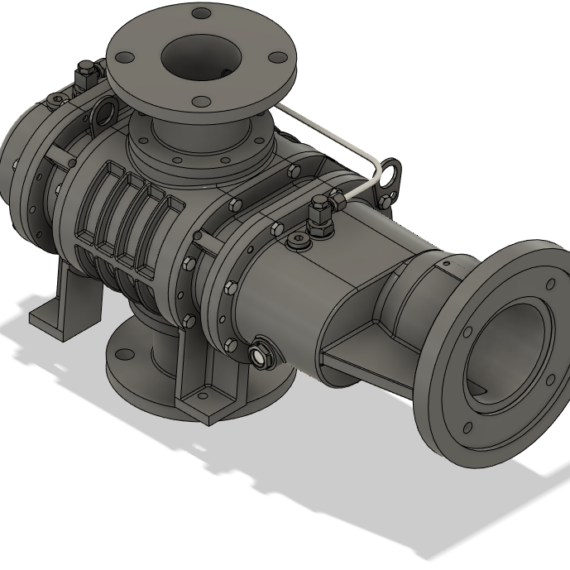
By implementation of a vacuum booster, the air flow rate and vacuum level is raised to an extent at which a smaller vacuum pump is able to achieve the final required vacuum level at the desired capacity or higher with less required horsepower, increasing efficiency through the decrease of installation and operational costs. The NB Series features a five-point bearing design with double oil tanks for structural security and convenience. Various internal coatings are available for selection, providing corrosion resistance against harsh process gasses to extend the service life of the booster.