
Filtration and Separation
Filtration is the process by which an impure liquid is run through a solid with pores of calculated and carefully manufactured size. The liquid leaves impurities in the solid as it passes through the pores so that the liquid becomes purer.
Depending on the application, vacuum filtration can be used to purify an impure liquid or to separate desired solids from a liquid-solid mixture or suspension. To filter a given mixture, it is flowed through a pipe or other tube of restricted cross-sectional area perpendicular to the flow. On this perpendicular axis, a filter is placed. This filter is a solid with pores sized to block certain molecules from passage while allowing smaller sized molecules to pass through. Atmospheric pressure and gravity are common forces utilized to push the mixture through the filter.
For macroscopic applications, this is the scope of filtration. However, as the pores tend towards the microscopic scale, further measures need to be taken, as using gravity to complete this kind of filtration can take hours or even days. Advancements in technology and research have led to different methods of overcoming this obstacle. One common method that has been used for several decades is pressure manipulation. Pressure is used to either push the mixture into the filter or pull the mixture through the filter. The process of manipulating the ambient pressure to pull the mixture through the filter is vacuum filtration.
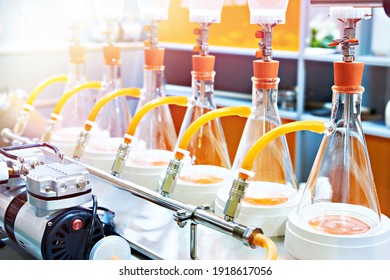
The typical setup of vacuum filtration in a laboratory setting consists of a funnel, filter, and suction flask. The funnel is properly fitted onto the top orifice of a suction flask. A filter is fitted into the restricted section of the funnel. Near the top orifice is a side orifice consisting of a short glass cylinder connecting the atmospheric air with the inside of the flask. A tube is properly fitted onto the side orifice and runs to a vacuum pump. The mixture is poured into the funnel and begins seeping through the filter at a minimal rate. The vacuum pump begins evacuating the flask, causing the pressure within the flask to decrease. The pressure differential between the atmospheric air above the funnel and the pressure within the flask increases, causing the atmospheric pressure to impose increased force on the mixture in the funnel.
When it comes to batch filtration in an industrial setting, the concept is similar, but with a different apparatus. One filter you may see is a drum filter. The vacuum is employed to pull the moisture out of the solid impurities, and to hold the remaining filter cake against the outer wall of the drum to be scraped off by the filter knife.
View our Products
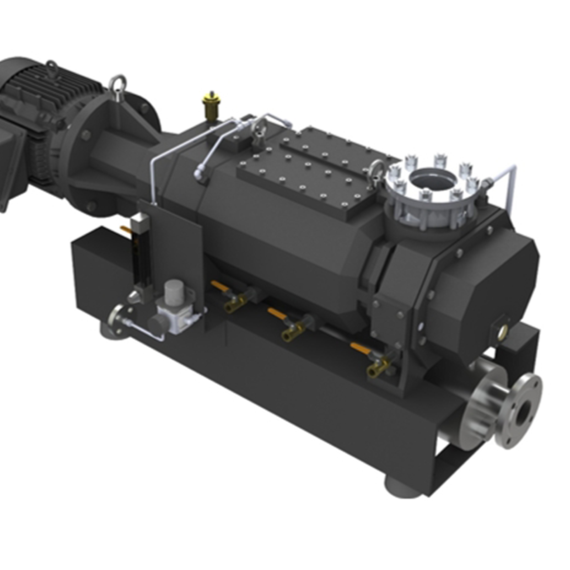
Vacuum filtration is used instead of or before evaporation or drying depending upon the nature of the mixture, such as the pharmaceutical research industry’s use of vacuum filtration to extract organic solvents from low concentration solutions. A dry screw vacuum pump is able to reach levels of vacuum that are far stronger than what is generally required for vacuum filtration. Thus, the dry screw vacuum pump is able to perform its duties at a sufficient level with less rotations per minute, consuming less energy and reducing wear. NES Company Inc. is proud to offer the NSP dry double screw vacuum pump series, complete with optional gas ballast, exhaust silencer, and spare parts kits.