
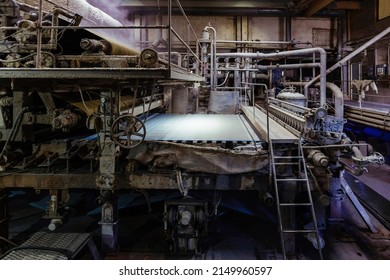
Pulping
The break-down of lignin bonds between cellulose bonds of plant matter for use in manufacturing products such as medical products, construction materials, food packaging, LCD screens, renewable fuels, and paper.
To make paper, trees are cut and taken to a pulping factory. The bark is not preferred for papermaking. Thus, the log is put in a rotating drum and agitated until the whole log is debarked. Depending on the kind of pulping, the logs may be processed into chips before transport.
There are two general categories of pulping: mechanical and chemical. The significant difference in the pulping methods is lignin treatment. Lignin is a dark polymer that increases rigidity within the cell walls and binds the cellulose fibers together, as well as dyeing the wood brown. To make paper, long cellulose fibers are preferred over short, jagged cellulose fibers. Chemical pulping results in longer, straighter fiber strands and stronger paper, since it dissolves lignin bonds instead of tearing them using heat and force. Mechanical pulping is cheaper and has much higher yield, but still has considerable lignin content.
To process the chips chemically, water, sodium hydroxide, and sodium sulfide are poured into a digester. Both sodium hydroxide and sodium sulfide reduce the lignin content of the chips. Sodium hydroxide solution is the most widely used for chemical pulping and has been shown to reduce lignin content from 60-90% depending on the concentration. Sodium hydroxide has a swelling effect on the plant material as it is absorbed, and this highly soluble compound breaks into ions and reacts with the pulp to break lignin bonds, bleaching the pulp and leaving mostly cellulose strands.
There are various forms of mechanical pulping, such as stone groundwood pulping, refiner mechanical pulping, thermomechanical pulping, chemi-thermomechanical pulping, and pressure groundwood pulping. These begin with finely grinding the chips into split fibers.
Stone groundwood pulping (SGW) involves pushing debarked wood logs against a rotating stone while cooling the grinding process with water. Refiner mechanical pulping (RMP) involves wooden chips becoming smaller chunks through a refiner with two grooved discs. Thermomechanical pulping (TMP) takes the steam generation of the RMP process into consideration and uses it to further break down the lignin-cellulose matrix. Chemi-thermomechanical pulping (CTMP) introduces very low-concentration alkaline solutions to weaken the lignin before undergoing the TMP process. Pressure groundwood pulping (PGW) incorporates SGW and TMP methods.
View our Products
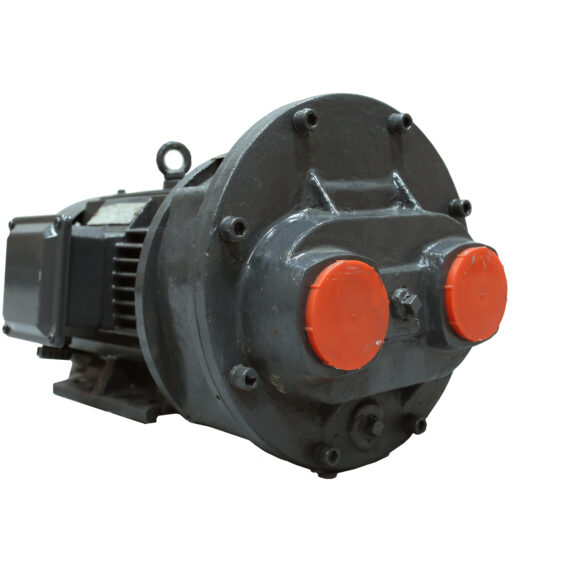
For many of the mechanical pulping processes, high pressure steam or pressurized hot water is extremely important in the denaturing process. The lignin is meant to be in the resulting pulp but needs to be weakened to the degree that long, unbroken cellulose fibers can be produced with forceful methods such as stone grinding or refiner grinding. Using a liquid ring compressor will provide the needed amount of pressure at a constant rate without any issues taking in vapor or liquid. The most common units for the application are the NHF Series units with Stainless Steel 316 construction and mechanical seals, providing excellent sealing and corrosion resistance for all pulping applications.