Dewatering, Drying, and Evaporation
The controlled manipulation of the liquid-to-gas phase change that yields the desired consequence.
Drying is the process of physically manipulating liquid in an absorbent solid to cause it to evaporate and leave the solid that it occupies. Drying can be used to the advantage of an industry depending on the desired result, such as that of chemical laboratories striving to distribute anhydrous compounds.
Vacuum drying is based on the physical principle that states that lowering the pressure of the ambient air around a liquid will lower the boiling point of that liquid. The boiling point of a liquid is dependent on the vapor pressure of the liquid and the ambient pressure. When liquid is heated, its temperature increases as the molecules of the liquid begin to gain energy, vibrating and colliding with one another. The surrounding air exerts a pressure on the liquid that prevents these colliding molecules from straying from each other, this causing the macroscopic phenomenon of a phase change.
At the temperature where the vapor pressure of the liquid is equal to the pressure of the ambient air, the liquid begins this phase change once it has gained enough energy to where the molecules are able to overcome their intermolecular bonds and the pressure exerted by gravity. From there, the molecules release their energy through the conversion of heat energy to kinetic energy, seen as liquid boils and temperature ceases to increase. When ambient pressure decreases, the energy required to overcome the pressure and evaporate the liquid also decreases.
Operation costs to dry batch products in atmospheric pressure can become staggeringly high from electricity expenses generated by heating elements. The technique of manipulating pressure to decrease the required heat energy for drying will cut operational costs significantly, as the power taken to operate the vacuum pump will not compare to the amount of power that is not being used to dry the product.
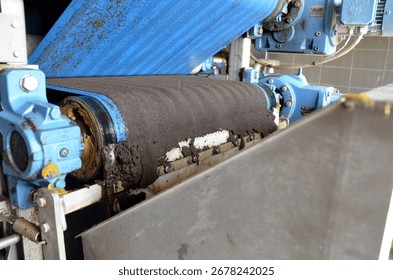
Some plants have ceased vacuum batch drying in favor of belt drying because of its continuous movement of products downstream. This means continuous feeding and discharging while completing the task of drying in real time affecting a product that is constantly in movement. The operating cost of a vacuum belt dryer does come out on top compared to batch drying processes, as the system is on throughout the entire operating day.
Belt drying is used commonly in the food industry because of the significant number of heat-sensitive products. This also applies to the pharmaceutical and chemical sectors of manufacturing. Applications such as pelletization, pharmaceutical tablet granulation, and Chinese herbal medicine drying require careful drying with risk of collapse, resulting in very poor-quality yield. In the petrochemical industry, extraction and refining involves tons of water that needs to be removed, but each desired compound is combustible. The lowering of boiling point to remove water from petrochemical compounds is important to achieve high quantity yields and prevent explosions.
The difference between vacuum dewatering, drying, and evaporation is the intended result. The goal of vacuum dewatering is to use vacuum to remove liquid from the product. The goal of vacuum drying is to have a solid product of a calculated minimal moisture content, applicable in products such as leather and pharmaceutical powders. The goal of vacuum evaporation is to remove a precise amount of liquid via phase change under vacuum; the desired product could be the vapor or the remnant.
Vacuum drying involves removing moisture from a material. It’s commonly used for heat sensitive materials like pharmaceutical powders and food products.
Vacuum dewatering is primarily a method to remove liquid water from wet materials, particularly in processes where the water is not intended to be completely evaporated. It is commonly used in papermaking, wastewater treatment, and preparation of sludges where significant moisture removal is required without complete drying.
Vacuum evaporation is a technique used to separate volatile components from a solution, primarily by removing a solvent. It is common in chemical manufacturing, food processing, and desalination processes. In vacuum evaporation, the moisture is not necessarily removed to be disposed of or recycled. Vacuum evaporation is also used for the removal of solvents or other evaporable substances as the desired product in and of itself.
View our Products
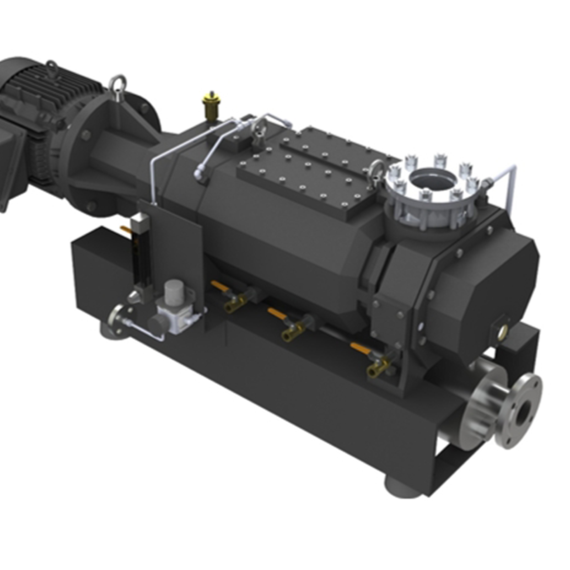
The dry screw vacuum pump has no working fluid to maintain or change, so it is not held back by the limitations of a working fluid’s vapor pressure. There is no risk of oil contamination, no expenses wasted by treatment and disposal of working fluid, and easy purging. The dry screw is of robust design and boasts a high capacity to power ratio, boosting efficiency and cutting down operation costs even further. The NSP Series is capable of achieving vacuum levels that are orders of magnitude higher than the recommended ultimate vacuum level used in the drying process, making it a reliable choice for drying, dewatering, and evaporation processes.
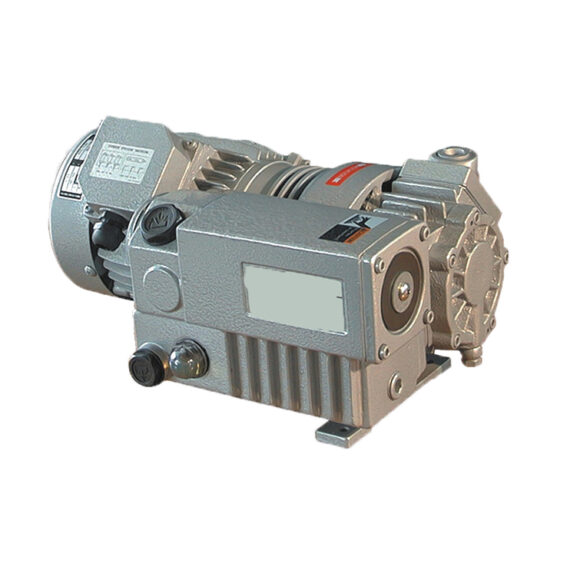
For medium vacuum applications in drying, an oil-sealed rotary vane vacuum pump is connected to a solvent or cold trap that is further connected to the drying chamber. This prevents moisture from entering the pump, allowing the unit to shine in its consistent performance in a compact, sturdy frame. The NRV Series is perfect for low to medium level vacuum applications in drying. The series models are built with robust, simple design that makes for a long service life with simple maintenance and repair.
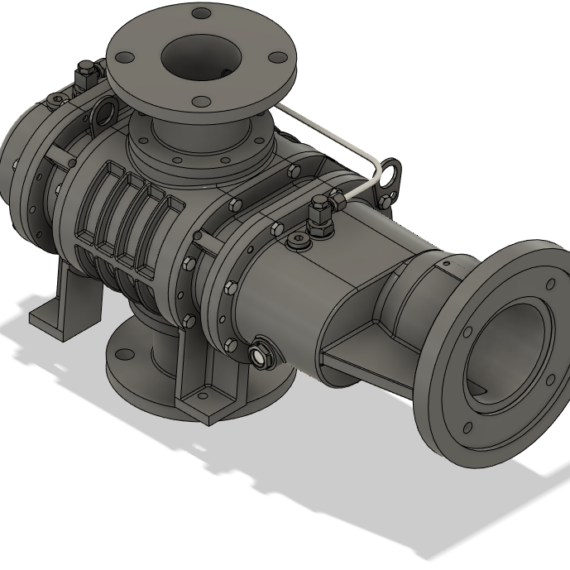
One of the major drawbacks of a vacuum belt dryer is the large power consumption of the process. To reduce these disadvantages, a vacuum booster is implemented. Vacuum boosters make for faster pumping speed and deeper achievable vacuum levels while requiring less power from the vacuum pump. NES Company Inc. offers the NB Series vacuum boosters that span a wide range of capacity, from 100 to 60,000 CFM with five-point bearing design and double oil tanks for added security and efficiency.