
Enhanced Oil Recovery
The process by which the overall yield of an oil refining procedure is increased.
Enhanced Oil Recovery is a term that covers a set of techniques implemented to increase oil extraction from a reservoir beyond what typical methods of extraction, like natural reservoir pressure and water flooding, can achieve. These techniques are based on three basic principles: ensuring pressurization in the reservoir through the injection of fluids like water or steam to push the oil towards the wells, reducing the oil’s viscosity to enhance mobility via heat or chemicals, and using the injected fluid to physically displace the oil from the reservoir to the wellbore.
The main categories of EOR can be boiled down to the following: thermal injection, gas injection, chemical injection, and microbe injection.
Before any technique is chosen, the oil reservoir is evaluated. Reservoir pressure, temperature, rock permeability and porosity, oil viscosity, and fluid composition are quantified so that an appropriate technique and system can be installed for the most efficient extraction process.
Thermal recovery is typically implemented for high-viscosity oils to increase the oil’s mobility and observe the desired flowrate. Steam injection is the most common technique, although methods like cyclic steam stimulation and steam-assisted gravity drainage are employed as well. Steam is generated at the surface through boilers and heat exchangers and injected into the reservoir through the injection well under high pressure, creating a steam chamber. The steam’s pressure and heat contribute to the reservoir’s rising pressure, which pushes the oil towards the production wells.
Gas injection techniques interact with the oil to reduce its viscosity and increase reservoir pressure. CO2, natural gas, and nitrogen are considered for injection depending on the conditions of the oil and the reservoir. CO2 injection is one of the most widely used gas injection methods, as it becomes miscible with the oil, weakening the intermolecular interactions of the oil. CO2 is compressed to a supercritical state so that it can travel easily through pipelines and inject efficiently.
Natural Gas Injection is implemented when a reservoir is found to have lighter oils. Methane or other light hydrocarbon gasses are injected, with sufficiently diminutive molecular size to penetrate all segments of the reservoir and increase extraction rates. Natural gas is more efficient than CO2 in filling pore spaces and reducing bypassed oil that cannot be mobilized through water flooding. Nitrogen is another considered gas, abundant and low-cost, particularly helpful for reservoirs with low permeability.
Chemical injection is typically delivered in a mixture with water or brine into the reservoir. These chemicals include surfactants, polymers, alkaline chemicals, or gas depending on the evaluation of the oil in the reservoir. The surfactants reduce the interfacial tension between oil and water, while the polymers increase the viscosity of the water, allowing for even distribution and increased control over the injection rate.
One interesting form of enhanced oil recovery is Microbe Enhanced Oil Recovery (MEOR). In some cases, naturally occurring microbes in the reservoir are stimulated to increase their activity through injection of nutrients. When there is an insufficient population, specific microbial strains including bacteria, fungi, or archaea are introduced. These microbes degrade heavy oil fractions to reduce viscosity, produce biosurfactants, produce CO2 and methane, and alter the wettability of the reservoir rock.
The “produced” water comes from condensed steam and naturally occurring water from the reservoir, containing dissolved gasses and solids. Oil-water API separators, emulsion separating electrocoalescers, and other produced water treatment systems are used to recover oil. The water is then treated via filtration, flocculant or coagulant treatment, reverse osmosis, evaporation, or membrane distillation.
The produced gas includes natural gasses like methane and propane, carbon dioxide, nitrogen, hydrogen sulfide, and some water vapor. The produced gas is sent to another liquid-gas separator, then amine gas treatment or caustic scrubbing are applied to sweeten the gas. Dehydration takes place to remove as much water vapor as possible, typically using the absorbent triethylene glycol. Amine absorption or membrane separation removes carbon dioxide should it appear in large quantities, in which case it can be recompressed and reinjected.
View our Products
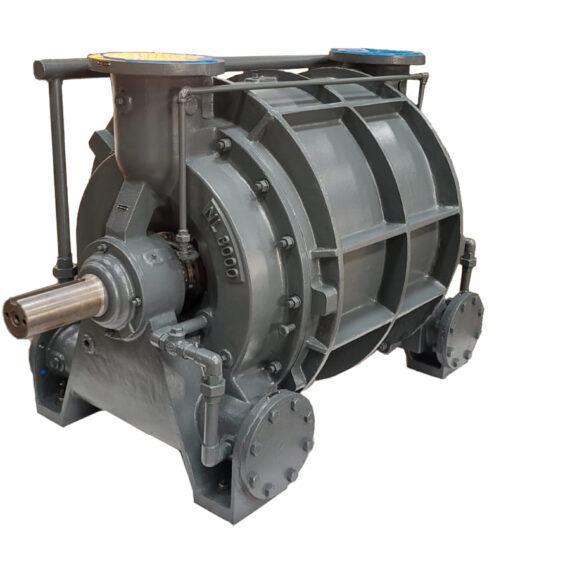
Liquid ring vacuum pumps and compressors are used in thermal injection for vacuum steam systems or to dewater condensate recovery processes. They may also be used in some chemical injection setups to remove water vapor, maintaining a stable chemical injection process. The NL Series is a drop-in replacement of the NASH CL Series, available in Stainless Steel 304 or 316 for proper corrosion resistance. NES Company Inc. offers the NL Series up to 9200 CFM with a two-year warranty against manufacturing defects.
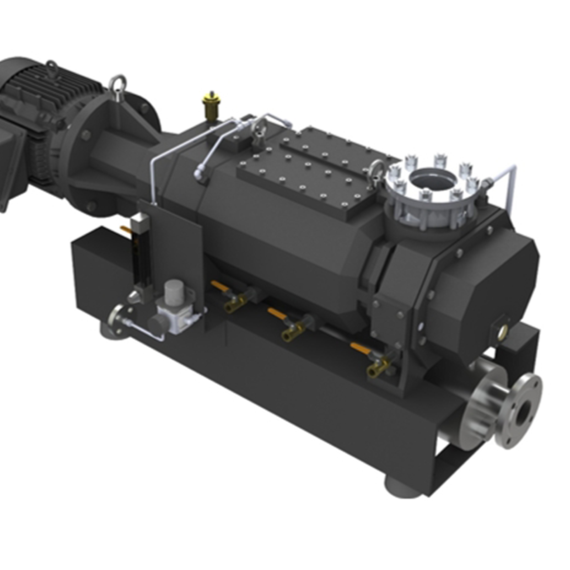
Dry screw vacuum pumps are used in thermal injection for compressing gasses like CO2 or air, which may assist in gas-assisted steam injection. Dry screw units are effective in gas injection for compressing CO2, nitrogen, and natural gas. The NSP variable pitch dry screw series is available in stainless steel at low capacities, with the cast iron option available up to 1766 CFM with a variety of internal coatings for chemical compatibility.
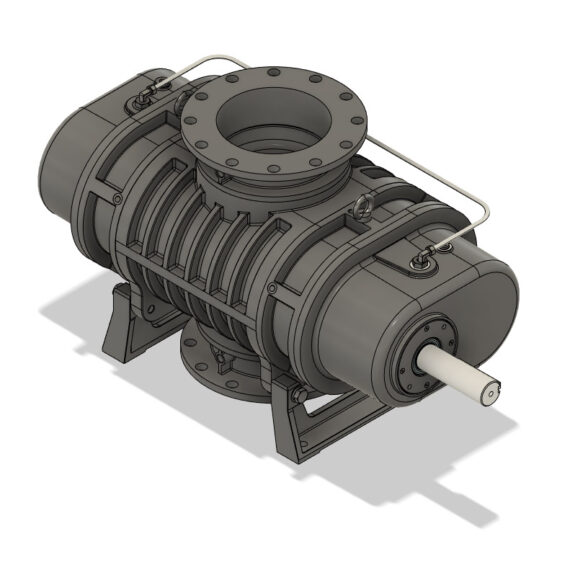
These are commonly used in thermal injection for air injection or gas-assisted steam injection, where moderate pressure is required. Roots-type blowers are reliable, can handle fluctuating flow rates, and are durable in harsh conditions. In foam-based chemical injection, blowers are often used to generate the gas phase. The NRB Series is robust and reliable, operating at high efficiency in vacuum and compression applications with a one-year warranty against manufacturing defects.
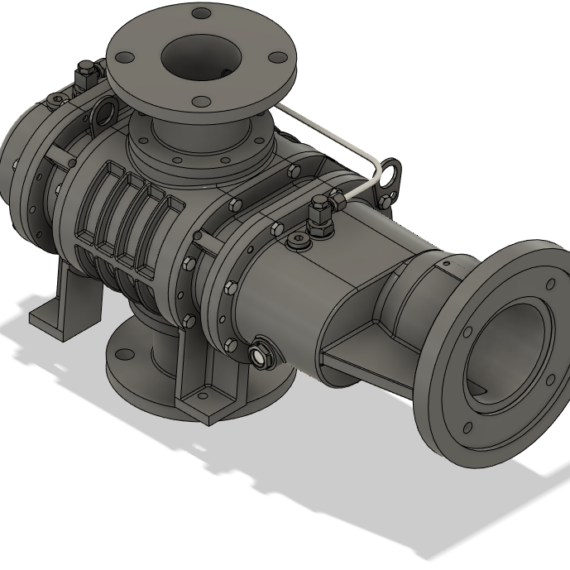
Roots-type boosters are used in some CO2 injection systems to increase the pressure of the gas before it is injected into the reservoir. Boosters are often implemented into vacuum or compression systems to increase the capacity of the system, as well as the vacuum level or compression capabilities. NES Company Inc. offers the NB Series as a solution for enhanced oil recovery applications. This series reaches 60,000 CFM with a one-year warranty against manufacturing defects.