
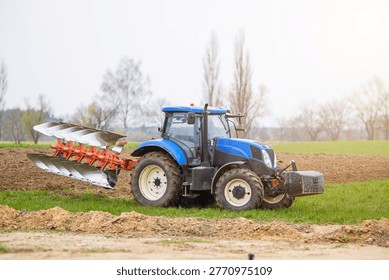
Farm Equipment
Equipment that is developed to further the speed, yield, and quantity of the products of the agricultural sector.
Farm equipment has evolved significantly, with modern technologies such as vacuum pumps and compressors improving yield, quality, and operation time. These innovations have become more and more integral to the optimization of agricultural operations as technology has become more advanced. Of these, milking is a simple, yet essential procedure that has been improved by vacuum technology.
Milking begins with the installation of a system. A vacuum pump provides the suction required for the operation, vacuum regulators control the level of suction, teat cups stimulate milk flow in a pulsating manner using the vacuum while holding a gentle but firm grip on the animal, pulsators alternate the vacuum pressure in the teat cups between milking phase and rest phase, milk receivers measure and collect the milk before it enters and damages the pump, a bulk tank cools and stores the milk, and a cleaning system uses hot water, detergents, or acidic solutions to clean out the hoses, piping, and other components of the system after milking is complete.
Seed and grain handling is also a good application of vacuum pumps and compressors. Depending on the mass flow rate, number of sources, number of distribution points, and grain size, a vacuum pump or compressor can be used. A vacuum pump is often used to pull from multiple sources, like in unloading multiple harvesters to a silo, while a compressor or blower is used to convey the material to multiple distribution points. Pneumatic conveying systems using vacuum pumps, compressors, or blowers are more efficient than mechanical conveying systems such as belts because they are able to pull the grain without supplying much more power to a span of conveyor belts.
Liquid pesticides and fertilizers can be fogged or sprayed over large distances, far overpowering the localized portable spray machines. This high-velocity atomization and discharge of liquid comes through the venturi effect, where a compressor or blower discharges high-velocity fluid over the piping of a tank of pesticide or fertilizer. This motive fluid creates a low-pressure area in which the liquid rises, and the air molecules bump into the liquid, breaking its intermolecular bonds apart and achieving the desired atomization effect.
Irrigation is the artificial application of water to land to create the possibility for agricultural production or to boost productivity. Particularly for places that have an arid climate, limited freshwater resources, or large-scale operations, it becomes necessary to have efficient use of water. One of the most water-efficient methods is drip irrigation, delivering water directly to the roots via piping and drippers. Vacuum filtration is required when debris is abundant in the water, cleaning and sending it through piping. Depending on the water and the specific application, fertilizers or pesticides could be injected through the same lines with the water in a process called fertigation that often pairs well with drip irrigation.
Vacuum harvesters are specialized machines used when a crop needs delicate handling, or when a larger-scale operation is looking for higher-efficiency harvesting methods. This encompasses the harvest of nuts, soft fruits, mushrooms, and herbs from Wisconsin (cranberries) to the Western Cape (various soft fruits) and from the Netherlands (fruits and vegetables) to New South Wales (nuts and soft fruits).
View our Products
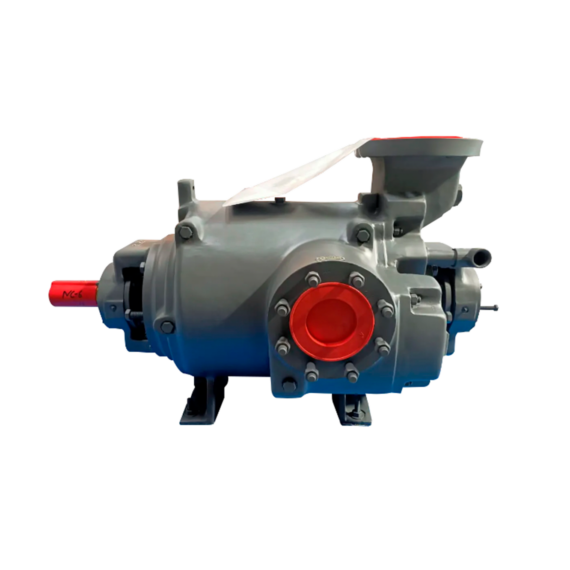
Liquid ring vacuum pumps are useful for vacuum requirements in the presence of moisture and other contaminants. The liquid ring vacuum pumps are extremely robust, known to last for years if not decades with scarce routine maintenance and simple repairs. In milking applications, washed seed and grain handling, vacuum fogging, fertigation, and vacuum harvesting, there is significant enough moisture and dirt that a liquid ring vacuum pump would ideally be involved. The NES NC Series is a single stage conical lobe vacuum pump and compressor series that can reach 28”HgV up to 3180 CFM.
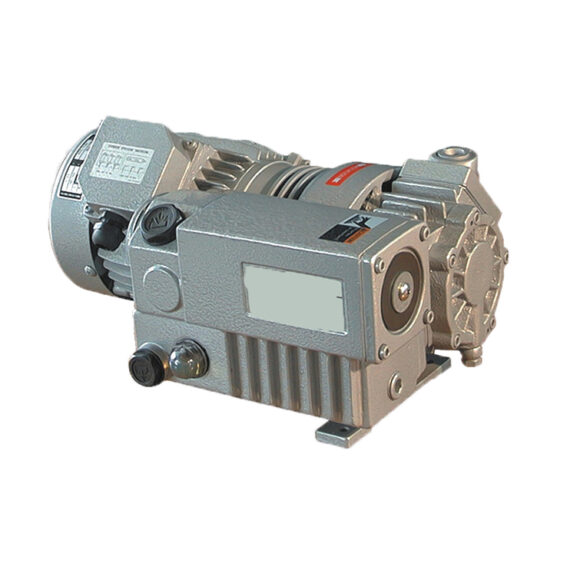
Rotary vane vacuum pumps are often used for smaller scale operations, held in regard as one of the most inexpensive yet efficient vacuum pumps in the modern market. These vacuum pumps cannot reach high capacities, nor can they reach high vacuum, but these units are light, compact, efficient, quiet, and easy to maintain and repair. NES NRV Series single stage oil-circulated rotary vane vacuum pumps reach 20 mbara up to 450 CFM and are covered by a one-year warranty against manufacturing defects.